

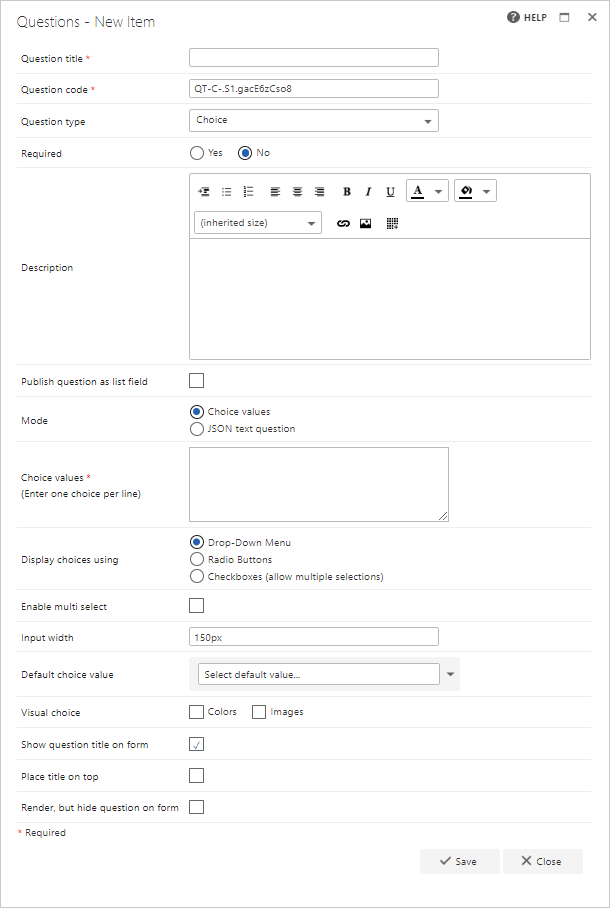
- Question title: each question must have a title. It’s a required field and will appear on the form as a label when the user fills in the question.
- Question code: each question needs a unique code. One is generated by default when you start creating a new question, but you can overwrite this and give it a different code if you prefer. The question code won’t appear on the form itself, but you can use it to search and filter when adding existing questions.
- Question type: choice.
- Required: you need to specify whether the question is required or not. If you set a question as required, the user must provide an answer to it on the form in order to submit the form. However, the user can still save the form as a draft without answering required questions. If you try to submit a form without answering all required questions, an error message will show a list of required questions that haven’t been answered.
- Question description: it’s optional whether you enter a description. The description is used as a tooltip on the form and will add an exclamation point beside the question on the form. If the user clicks on the exclamation point, the description entered (tooltip) will appear.
- Publish question as list field: check this box to save the question to the SharePoint forms list. This allows you to report on the question from there.
- Mode: you can decide to display predefined static choice values, or retrieve choice values from a “JSON text question”. See JSON Text Question for more detail on setting up a JSON choice question.
- Choice values (enter one choice per line): enter the answers you want to appear as options in this question. You need to enter each answer on a separate line, so ensure you hit enter and start a new line for each item.
- Display choices using: select how you want the options presented. You can use a drop-down menu, radio buttons, or checkboxes. Only checkboxes allow the user to select multiple options.
- Enable multi select: for a drop-down menu, check this option if you want the user to be able to select multiple options.
- Input width: set the width of a drop-down menu here. The value must be entered in pixels (px).
- Default choice value: if you want a value to be displayed as the default option, you can select it here. For a drop-down menu or radio buttons, you can only select one default value. For checkboxes, you can set multiple default options, if required.
- Visual choice: you can use this option to display visuals (images/colors) as/beside text options.
- Colors: you can display colors as choice options, or alongside text options (e.g., a traffic light system - green/amber/red)
- Mapping: you will need to provide text options, then in mappings associate a color to the text option
- Mode: select the option for how you want the choice values to be displayed to the user
- Visual + text: will display the color mapping and text value
- Visual: will display only the color mapping
- Text: will display only the text value, ignoring the color mapping
- Shape: select what shape you want the visual color mapping to be displayed as
- Square: visual color mapping will display as a square
- Circle: visual color mapping will display as a circle
- Images: you can display images/icons as choice options, or alongside text options (e.g., a ranking between 1-5 stars)
- Mapping: you will need to enter text options, then in mappings associate an image URL to the text option
- Mode: select the option for how you want the choice values to be displayed to the user
- Visual + text: will display the image and the text value
- Visual: will display only the image
- Image size: you will need to decide how image sizes are handled
- Width: this value, entered in px, will act as the default width for all images
- Max width: this value, entered in px, will act as the max width for large images, and will only downsize images larger than this width
- Colors: you can display colors as choice options, or alongside text options (e.g., a traffic light system - green/amber/red)
If you are using images in a dropdown menu, they will all automatically be resized.
- Show question title on form: check this option if you want to display the question’s title to the left of the question’s input field. If you uncheck this option, the input field is moved to the left and appears under the other questions/question titles.
- Place title on top: check this option to display the question’s title above the input field. If you uncheck this option, the title appears to the left of the input field, as normal.
- Render, but hide question on form: if you check this option, the question will behave as if displayed by default. Default value, publishing and calculation will apply despite the question not being displayed on the form.